← Back to the library
Library

Aylesford Pieces, No.3 — Gavotte

George Frideric Handel · Aylesford Pieces · Baroque · level 2

240Notes
0:52Length
36–83MIDI

About this piece

George Frideric Handel
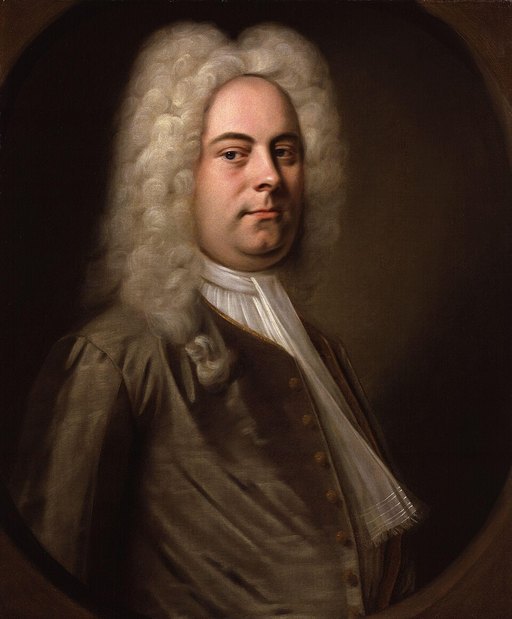
Portrait: Attributed to Balthasar Denner, Public domain (via Wikimedia Commons)

George Frideric Handel (1685–1759) was born in Halle and died in London; he belongs to the Baroque period. He settled in London in 1712 and was naturalised as a British subject in 1727, and his works are catalogued by the Händel-Werke-Verzeichnis (HWV). The Aylesford Pieces is a set of keyboard pieces whose third number is a Gavotte. The set is named after the Aylesford collection of Handel manuscripts; it carries no opus number, and no year of composition or copying is documented for it. The gavotte is a French dance in duple metre and moderate pace that became a standard movement in Baroque instrumental suites. Schott published an edition of the Aylesford Pieces in 1930, and the present score follows that edition. No dedication by Handel for the set is recorded, and no premiere of it is documented.

Where this comes from: https://www.mutopiaproject.org/cgibin/piece-info.cgi?id=151

About this score

Composer: George Frideric Handel (public domain) · Score source: https://www.mutopiaproject.org/cgibin/piece-info.cgi?id=151

Licence: public-domain · Source

Why it is public domain: Died 1759. Public domain in China from 31 December 1809 (life + 50) and in the EU from 31 December 1829 (life + 70); the edition we copied predates 1930.

About the composer

George Frideric Handel · 1685–1759

German-born British composer, the defining figure of Baroque oratorio and concerto. His keyboard suites and arias are often arranged as piano study material.

Wikipedia entry ↗

What every control on this page does

This page is the score’s passport: what it is, where it came from, and how to start playing it.

Starting to play

Practise this piece
Opens the practice page for this piece: falling notes or turning pages, with judging and a score at the end.
Stop
The audition button turns into this while the piece is playing — it stops the playback (auditions play the first 45 seconds).
Add to my scores
Copies the score into My scores, so it follows your account and can be edited or exported.

What the numbers are

Notes
How many notes you will play if you practise it end to end.
Length
Playing time at the written tempo.
Level
Difficulty 1–8, which is also what decides the stage it sits in on the library page.

Where it came from

About this score
The attribution line: who published this edition, and who prepared it.
Licence
The licence the edition is under. Links go to the rights page, not to a paywall.
Source
The source we took the score from — Mutopia Project or an IMSLP scan.
Why it is public domain
Why we say this piece is public domain: the composer’s death year and the edition’s year.
About the composer
A short note on the composer, with the years they lived.
Wikipedia entry
Opens the composer’s Wikipedia entry in a new tab.
We have a public-domain scan of this piece but no machine-readable score yet, so it cannot be practised in the browser today. The source link above is the scan.
Shown only for scan-only pieces: we hold the scan, but there is no machine-readable score to practise yet.
Where this comes from
The source the background note was written from — a Wikipedia entry, an IMSLP page or a public-domain edition’s preface. Pieces without a source do not get a background note at all, and a note that no human has checked is not shown either.

Your record on this piece

Your record on this piece
This block reads the progress kept in this browser (the same progress the practice page writes) and never uploads it.
Best score
The highest score you have reached on this piece, out of every run so far.
Played
How many times you have played it through to the end.
Grade
The grade from your best run — S/A/B/C/D, the same scale the desktop client uses.
Last played
The date of your most recent run.
Your last {n} runs, oldest on the left (vertical axis: share of notes you got)
The line chart: each point is one run, oldest on the left, and higher means you got a larger share of the notes. With fewer than two runs there is nothing to draw.
Every run in this browser, newest first
Every run recorded in this browser, newest first, with the score and the share of notes you actually hit. The chart above shows the trend; this table shows the numbers behind it. Runs older than the last ten are not listed — only the trend line keeps the full history.